Three polls were published in the final stretch of the 2026 campaign. All three correctly called a Labour victory. All three landed within their stated margin of error on both major parties. And by the international benchmarks used to judge polling accuracy, all three performed well.
That is the headline, and it is worth stating plainly before the numbers, because much of the post-election commentary has focused on a single figure, the gap in absolute votes, that is the least reliable way to measure a poll’s accuracy. This piece sets out how each poll performed against the final result, why percentage share is the measure that matters, and why the absolute vote gap tells a more misleading story than the underlying data warrants.
The 2026 general election produced a result that, on the final result published by the Electoral Commission, gives Partit Laburista 51.8%, Partit Nazzjonalista 44.7%, and other parties 3.6%, on a turnout of 87.5%. With those figures now confirmed, this is a moment to look back at the three published polls of the campaign and ask a straightforward question: how accurate were they?
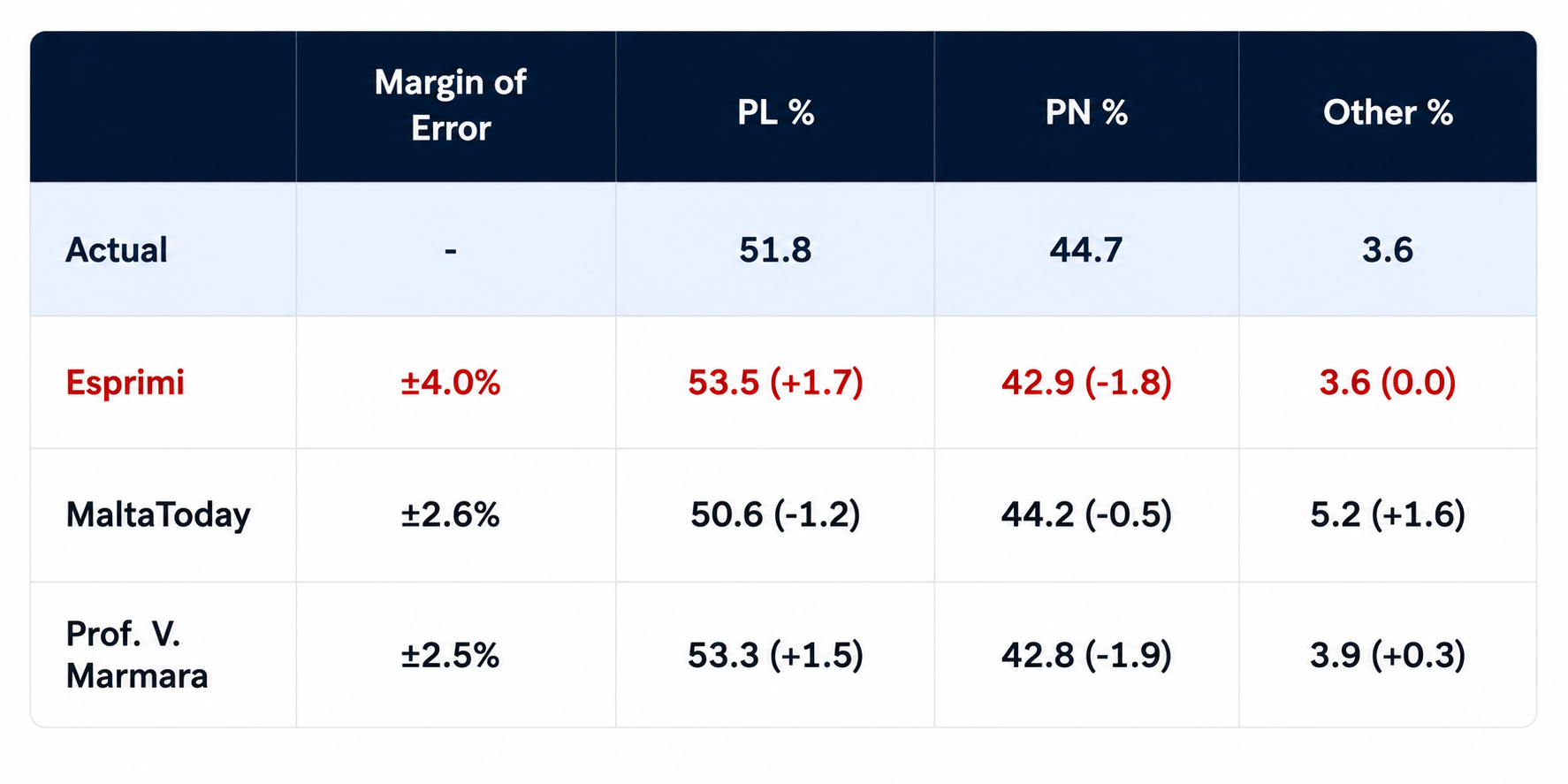
The Esprimi survey, commissioned by Times of Malta, projected PL at 53.5%, PN at 42.9%, and other parties at 3.6%, on a margin of error (MoE) of ±4%. Malta Today’s own poll projected PL at 50.6%, PN at 44.2%, and other parties at 5.2%, on a margin of error of ±2.6%. The survey by Professor Vincent Marmara projected PL at 53.3%, PN at 42.8%, and other parties at 3.9%, on a margin of error of ±2.5%.
Predicted vs Actual Turnout
Turnout: the harder question
It is worth noting the variable that separated the polls most clearly: turnout. This is widely regarded as among the most difficult variables to estimate in election polling, because it depends on respondent intention translating into action on polling day. Among the three pollsters, only Esprimi and Malta Today published a turnout projection in their final pre-election survey. Esprimi projected a turnout of 88.9%, against an actual figure of 87.5%, a difference of 1.4%; Malta Today projected 79.2%.
Within margin of error
On the headline party shares, the most important observation is that all three polls landed within their stated margin of error on both major parties. This is the standard against which polling is judged internationally, and on that standard, all three pollsters delivered a credible result.
Why the absolute vote gap tells a different story
Much post-election commentary has focused on the gap in absolute votes between the two parties. It is a reasonable question: our poll projected a gap of approximately 33,600 votes, so why did the actual gap come in at around 21,700? The answer lies in understanding what polls measure and, equally, what they do not.
A poll measures the percentage share of voter intention at a given point in time. It does not, and cannot, predict the precise number of valid votes each party will receive on election day. The translation from percentage to absolute number depends on two variables that no pollster can know in advance: how many people will vote, and how many of those votes will be valid.
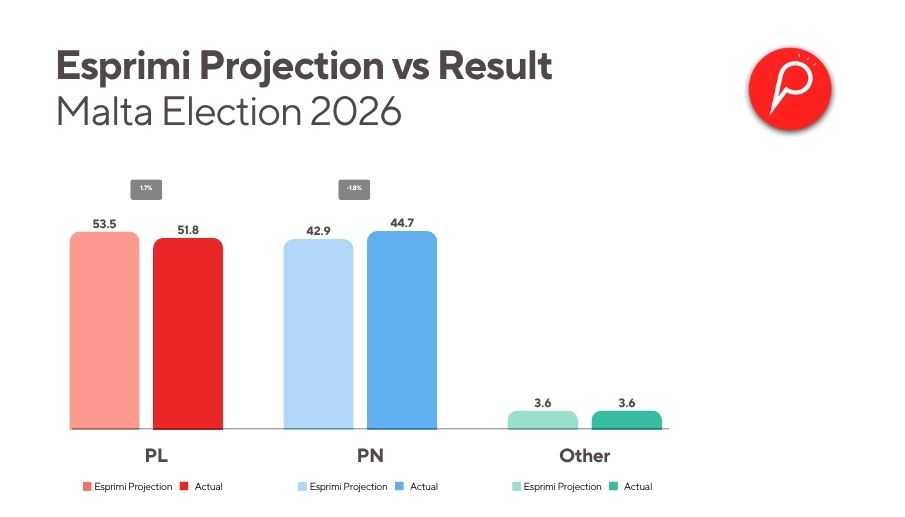
In this election, Esprimi projected a PL-PN gap of 10.6%; the actual gap was 7.1%. This 3.5% gap difference is due to the prediction error of the two major parties by 1.7% and 1.8% respectively, both of which were within margin of error. This is why, across the major democracies, polls are reported and judged on percentage share, not absolute vote counts. It is the international standard, and it is the standard Esprimi will subscribe to going forward.
The table below shows the party-by-party breakdown in both percentage and absolute terms.
Projection vs actual result
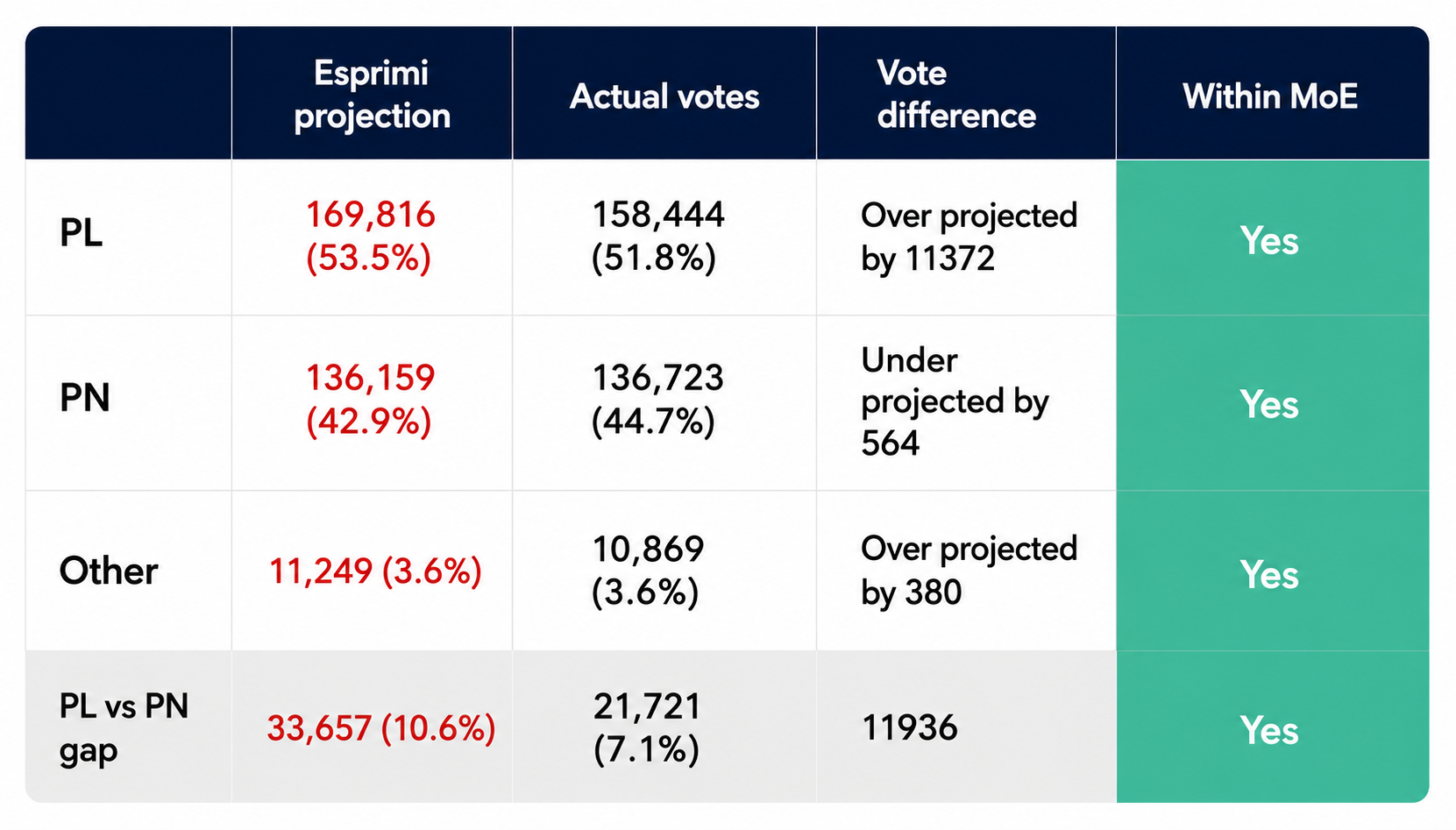
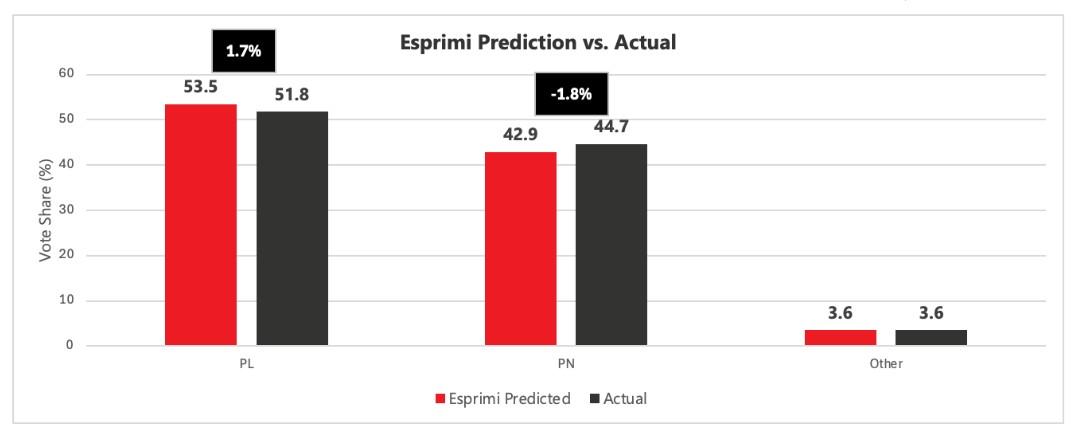
The figure illustrates a point worth stating plainly. A 1.7% over-projection of PL and a 1.8% under-projection of PN is an error that, although small and within the margin of error, compounded in the absolute gap figure, making the headline number look larger than the underlying percentage performance warrants. Other parties were called with perfect precision, at 3.6%.
There is a point that is widely understood internationally but rarely stated in the Maltese debate. The margin of error on the gap between two parties is roughly double the margin of error on each party individually. A poll with a ±4% margin of error per party carries a margin of approximately ±8% on the gap between the two parties. Esprimi’s projected gap of 10.6% and the actual gap of 7.1% differ by 3.5 points. Measured against that standard, Esprimi’s projected and actual gaps are well within tolerance.
Accuracy itself is best measured by average deviation per party. On that measure, the internationally recognised benchmark, Esprimi’s average error across the three categories was approximately 1.2%. International polling research generally regards an average deviation under two points as highly accurate, given that the typical polling error across democracies falls between 2 and 3.5%. By that standard, all three Maltese pollsters performed well.
There is a further reason percentage share matters, and it goes beyond methodology. How numbers are presented shapes how people understand them. A headline expressed as a gap of tens of thousands of votes lands very differently in the public mind than the same finding expressed as a percentage, and there is well-documented international evidence that perceptions of who is winning can influence voter behaviour, a phenomenon researchers call the bandwagon effect. Published research carries a responsibility, because it not only describes public opinion, it can shape it.
Looking forward
Our individual party results fell within the stated margin of error and we stand by the scientific methodologies we applied. As part of our post-election back-testing, we will examine how we can refine our models to best predict voter movement, whilst continuing to evolve our approaches to data collection in order to represent public opinion more faithfully than traditional methods have allowed us to so far.
We are excited to see what the future of opinion polling looks like, and we kickstart that process right now.
Morgan Parnis
CEO & Founder, Esprimi